Understanding
Black and grey micro-realism: definition, technique and the work of detail
Published on 12 April 2026· Updated on 12 May 2026
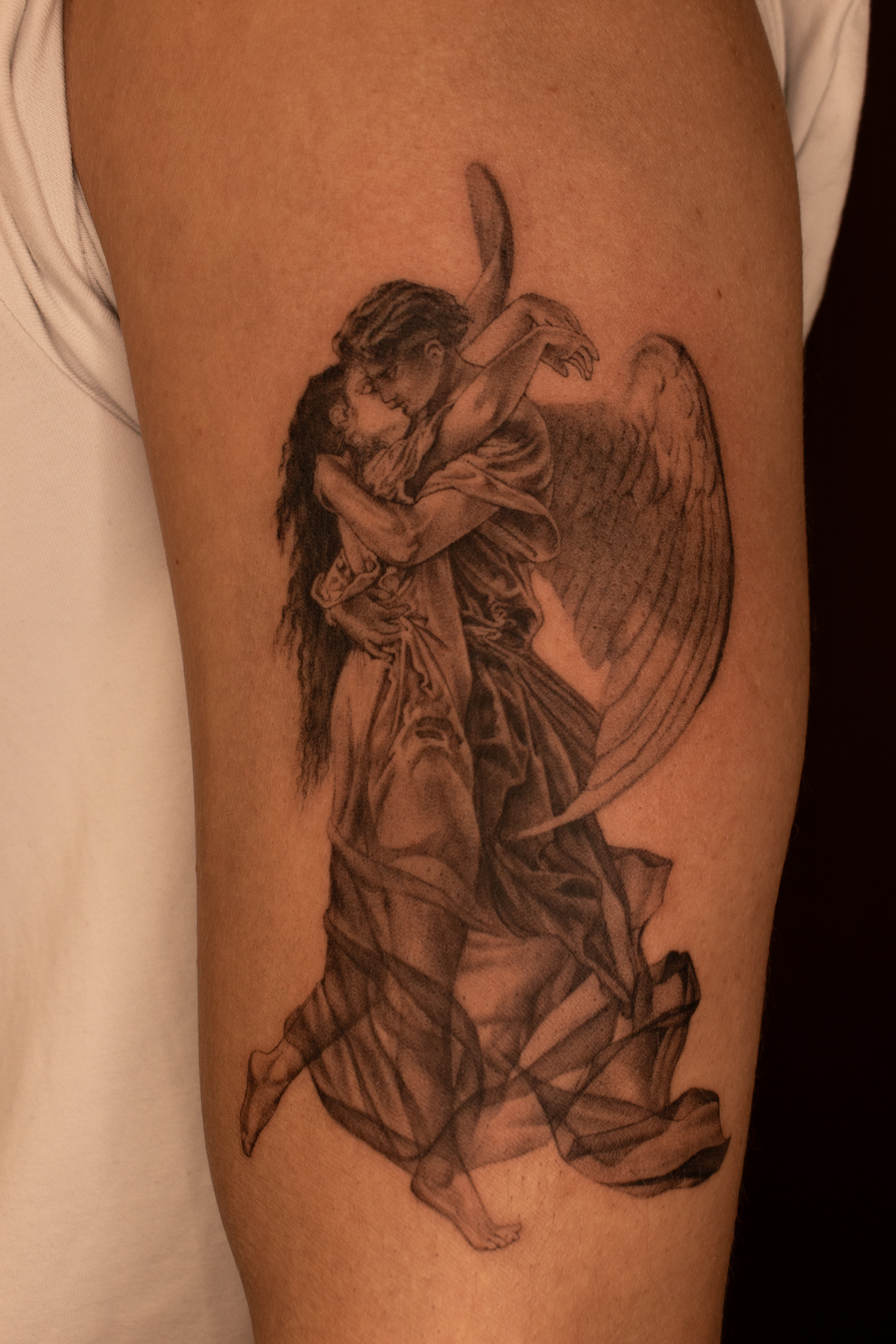
Black and grey micro-realism is a tattooing technique that reproduces realistic images at a small scale, using only diluted black and grey tones, without colour. The goal is maximum detail, depth and softness on a small area of skin, for a result close to pencil drawing or engraving.
Micro-realism vs classic realism: what is the difference?
Classic realism aims to faithfully reproduce an image, often at a large scale to preserve detail. Micro-realism applies the same demand for precision, but on a deliberately small piece: a cameo, a forearm, a rib. The technical constraint is greater, because every line must stay legible and heal well over time. It is one of the most demanding disciplines in contemporary tattooing.
Why black and grey, without colour?
Working in black and grey relies on contrast, gradients and light management rather than coloured pigments. This absence of colour gives black and grey micro-realism its timeless, drawing-like quality, and it tends to age better than colour, which is more sensitive to light and time.
Working gradients, textures and depth
The heart of micro-realism lies in the subtlety of gradients: soft transitions between values, textures (skin, fabric, metal, feather, stone), highlights and depth that create the illusion of volume. It is patient work where each area is built in layers, seeking a result close to the perfection of the real.
Which subjects suit micro-realism?
Black and grey micro-realism is particularly suited to portraits, neoclassical sculptures (after Bouguereau, for example), animals, botanical work and architectural compositions. It is ideal when you want a discreet yet richly detailed piece that ages gracefully.
Micro-realism and tattoo longevity
A well-designed micro-realism piece factors ageing into the drawing from the start: enough spacing between details, controlled contrast, placement suited to the body area. A piece that is too dense on a high-wear area will lose legibility. This is why the prior study of the composition by a specialised artist is decisive.
Frequently asked questions
- Does micro-realism age well?
- Yes, provided the linework is designed to last: enough spacing, controlled contrast and a suitable placement. A piece that is too dense on a high-wear area will lose legibility, which is why studying the composition beforehand is essential.
- What is the minimum size for micro-realism?
- It depends on the subject. A face needs more room than a simple object. As a rule, going below 8–10 cm on a complex subject compromises healing and long-term legibility.
- What is the difference between micro-realism and fine line?
- Micro-realism seeks the volume, gradients and depth of a realistic image at a small scale. Fine line favours a delicate, graphic stroke, often minimalist. Both can be combined within a single composition.